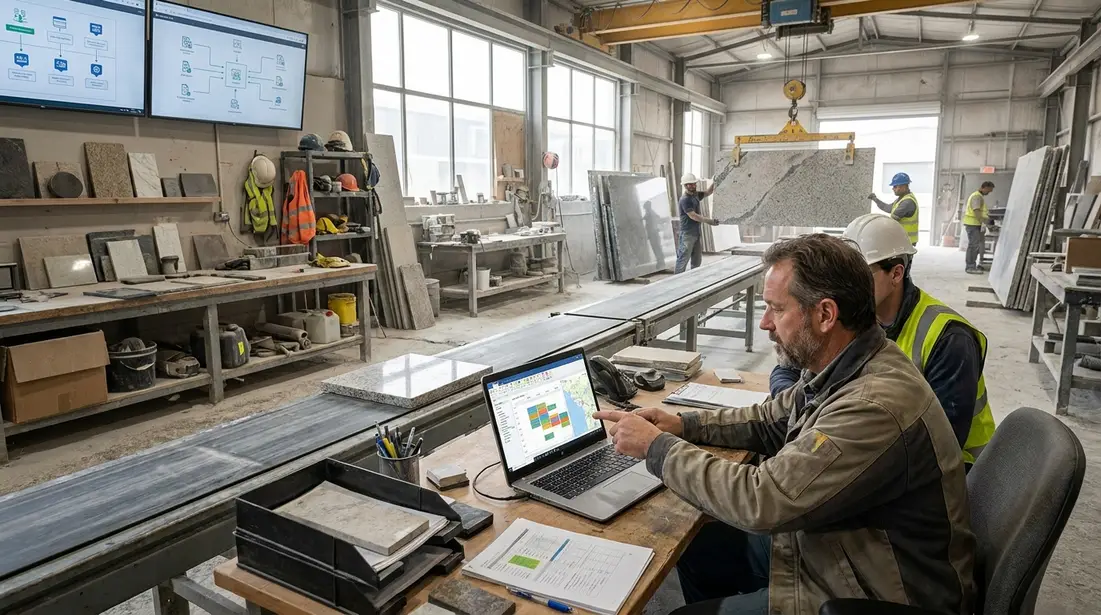

Best Worktop Software for UK Stone Shops
Discover the best worktop software for UK stone shops and see how CutBench, Moraware, ActionFlow, and SlabWare compare. This guide shows which stone software cuts admin, improves scheduling, and keeps quotes, templating, fabrication, and installs on track.
The best worktop software for stone shops that need less chaos
If you run a stone shop, you already know the hard part isn’t just winning work. It’s keeping every job moving without dropped details, missed site visits, scheduling clashes, stock mix-ups, or install-day surprises. That’s the real challenge. The right worktop software can make a big difference.
We looked at leading options used by countertop and stone fabrication businesses and compared them based on how a real UK worktop operation works. Not just generic job management. The focus was on quoting, templating, fabrication, scheduling, install coordination, customer communication, and the office-to-site handoff. If you’re weighing up stone software to replace spreadsheets, paper packs, wall planners, or a tool built for a different trade, this guide should help.
The aim is simple: find the platform that fits how a granite, quartz, marble, or kitchen worktop business actually runs day to day. Some systems handle inventory well. Some lean more on automation. Others are built more clearly around the full enquiry-to-invoice process.

What we reviewed
- Cutbench
- Moraware
- ActionFlow
- SlabWare
Best worktop software picks for UK stone shops
1. Cutbench
At a Glance
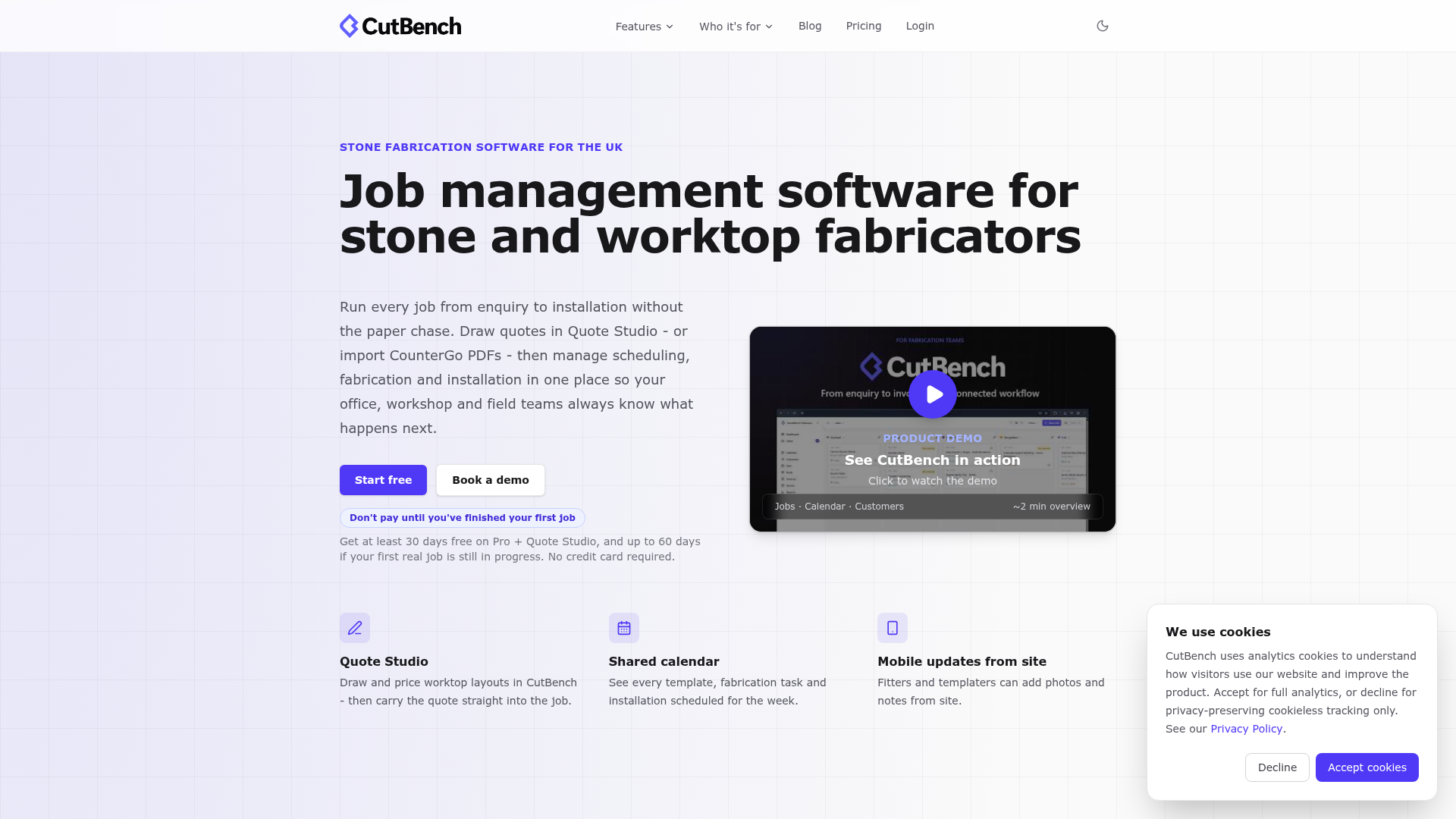
CutBench brings the full day-to-day workflow for UK stone and worktop fabrication businesses into one place. It doesn’t ask a stone shop to squeeze its work into a generic CRM or field service system. Instead, it covers enquiry, quote, templating, fabrication, installation, stock, invoicing and team coordination in a way that fits how these businesses actually run. Very practical. The platform works especially well for shops that want one shared system for office staff, templaters, fitters and managers. For teams tired of chasing updates through calls, WhatsApp, spreadsheets and paper folders, CutBench will likely feel like the clearest fit on this list.
Core Features
- Quote creation and management for worktop jobs
- Quote Studio for drawing and pricing layouts like L-shape, U-shape and islands
- Visual pipeline with board, list and table job views
- Templating, fabrication and installation workflow tracking
- Shared team calendar with scheduling for site measures, production and installs
- Customer management, lead follow-up and conversion from enquiry to job
- Stock, invoicing and a connected enquiry-to-invoice workflow
Pros
- Built for UK stone shops: The system is shaped around the needs of worktop fabricators, not plumbers, builders or wider service teams.
- One workflow from lead to payment: Sales, operations and field teams work from the same live job record instead of passing work between separate tools.
- Strong scheduling visibility: Shared calendars and stage-based tracking help owners and office teams see what’s booked, what’s blocked and what needs attention next.
- Quoting that matches real worktops: Drawing and pricing tools give a real advantage to shops that need more than simple line-item quotes.
- Easy to follow for mixed teams: Owners, office staff, templaters and fitters all need different details. CutBench keeps everything organised without making the system feel too heavy.
Who It’s For
CutBench is a strong fit for small to mid-sized UK stone fabrication and installation companies that want to replace disconnected systems with one tool. It suits granite, quartz, marble and kitchen worktop businesses that need tighter control over quoting, handoffs, scheduling and job status across office and field teams. No fuss.
Unique Value Proposition
CutBench stands out by linking many parts of the business in a way that matches how stone shops actually work. A quote becomes a job. A job moves into templating. Templating passes into fabrication. Then fabrication moves into install. The calendar, team updates, customer record and workflow stay linked the whole way through. That cuts admin, helps teams avoid missed details and gives managers a clearer view of capacity and progress without a daily paper chase.
Real World Use Case
A growing worktop company with two templaters, one fabrication team and multiple install crews can use CutBench to stop jobs getting stuck between departments. The office creates and tracks quotes, templaters can see site appointments, production follows live job stages and installers work from clearer handoff information. As a result, teams make decisions faster, spend less time on internal calls and give customers a smoother experience.
Pricing: From £79/month
Website: https://cutbench.io
2. Moraware
At a Glance
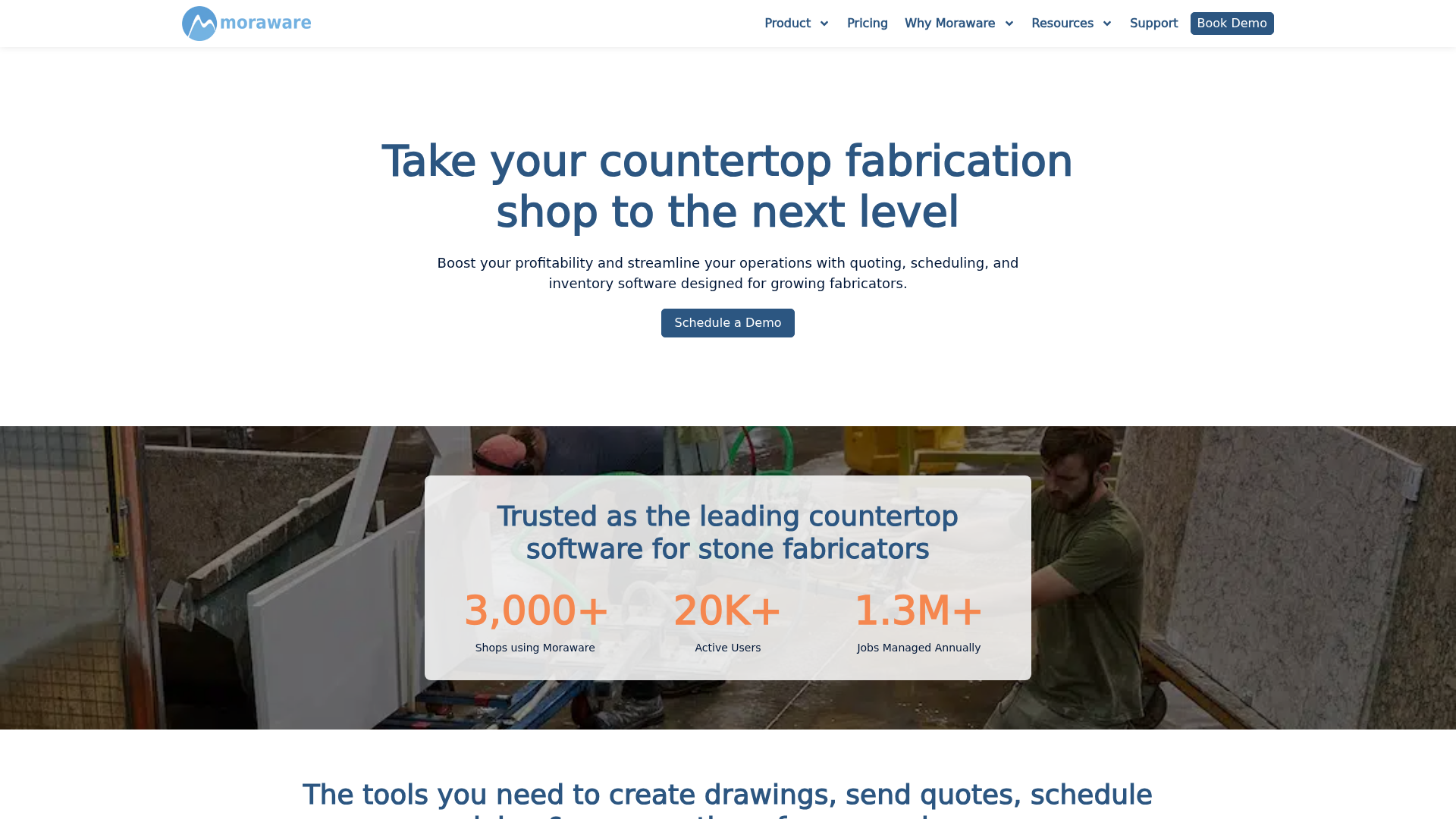
Moraware is one of the best-known names in countertop software. Fabrication shops have used it for a long time for estimating, scheduling, and inventory tools built for the stone trade. It’s a solid option for shops with a steady flow of jobs and more complex production planning. Because Moraware focuses on countertop-specific workflows instead of general contractor management, it can feel more relevant than broader job software. For some UK buyers, though, the modular setup and less visible pricing can slow down the review process.
Core Features
- Countertop drawing and estimating
- Scheduling for templating, fabrication, and installation
- Slab ordering and inventory assignment
- Job status tracking for shop teams
- Workflow management across departments
- Countertop-focused production coordination
Pros
- Established reputation: Moraware is widely seen as a long-standing standard in countertop software.
- Industry-specific workflow: It was built for fabrication shops, not adapted from a general trades platform.
- Good operational depth: Moraware handles estimating, shop workflow, scheduling, and stock-related needs well.
- Strong for busier shops: Teams with more moving parts may get real value from the range across production and coordination features.
Cons
- Less pricing clarity: Public pricing is hard to confirm through official sources.
- Modular setup can add cost: Separate products or modules may increase the total spend over time.
- Sales-led buying process: Some buyers may want a faster self-serve evaluation path.
Who It’s For
Established countertop fabrication shops that want deep, industry-specific workflow support may find Moraware a strong fit, especially if they’re comfortable with a more traditional software buying process. It can also work well for operations-focused teams with enough job volume to make a more layered setup worth it.
Unique Value Proposition
Its main value comes from how mature it is in the countertop space. It’s not trying to do everything for every trade. Many fabrication shops already know the workflow style, especially around estimating, production, and scheduling, and that familiarity can make the software feel like a more natural fit. For a shop that wants proven countertop-specific software and can live with less transparent pricing, Moraware remains a serious option.
Website: https://www.moraware.com
3. ActionFlow
At a Glance
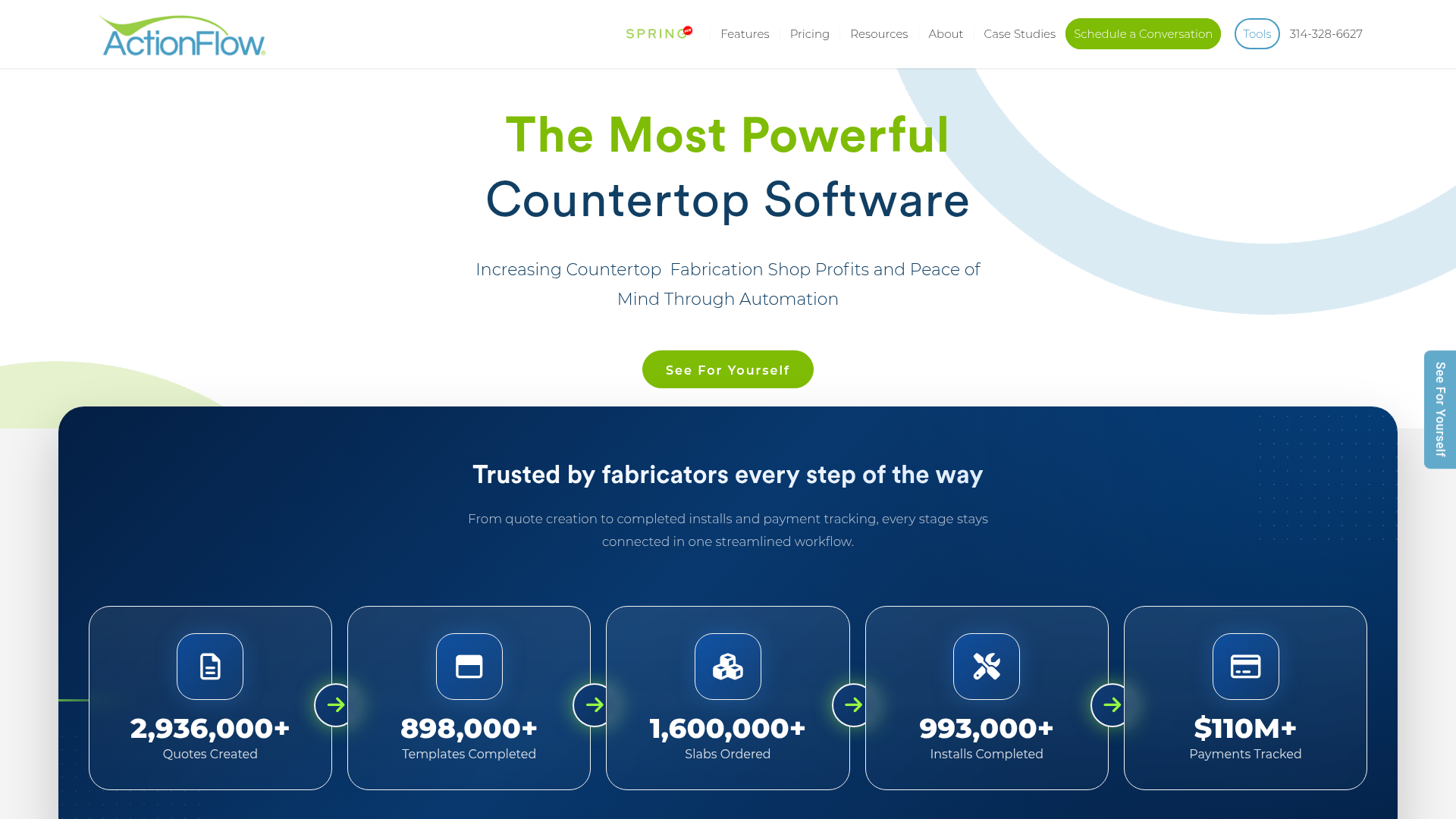
Built with automation at its core, ActionFlow helps countertop shops move jobs from one team to the next with less manual follow-up. That can make it a strong fit for shops where delays happen between quote approval, templating, programming, fabrication and installation. It centralises data and reduces friction during handoffs. For stone businesses that feel bottlenecks more than sales issues, ActionFlow may be appealing. Smaller shops that want something very simple, though, may find it offers more structure than they need.
Core Features
- Quoting and drawing tools
- Automated workflow and task handoffs
- Inventory management and barcoding
- End-to-end job tracking
- Centralised cloud-based data
- Workflow support across template, fabrication and install
Pros
- Automation-focused: Good for shops that want to reduce manual coordination between departments.
- Clear operational mindset: Built around moving workflow, not just basic record-keeping.
- Useful for bottleneck reduction: It may help teams where jobs slow down between stages.
- Centralised visibility: Shared information can support planning and communication.
Cons
- Limited official pricing transparency: Public pricing on the official site isn’t clearly laid out.
- Possible setup costs: Some third-party sources mention implementation fees on higher tiers.
- May feel heavy for simple shops: Smaller teams with lighter workflows may not need this level of structure.
Who It’s For
Best suited to operations-heavy fabricators, ActionFlow works well for teams that want more automation and tighter control over processes between departments. If a shop struggles with slow handoffs from office to template to shop to install, this platform is worth a closer look.
Unique Value Proposition
Its main strength is process flow, not just quoting or inventory. The value is strongest when a shop handles enough job volume that coordination becomes the main pain point. In that kind of setup, the automation-first design may help jobs move more smoothly through the business.
Pricing: Third-party sources cite plans from about US$149/month, US$299/month and US$499/month
Website: https://www.actionflow.net
4. SlabWare
At a Glance
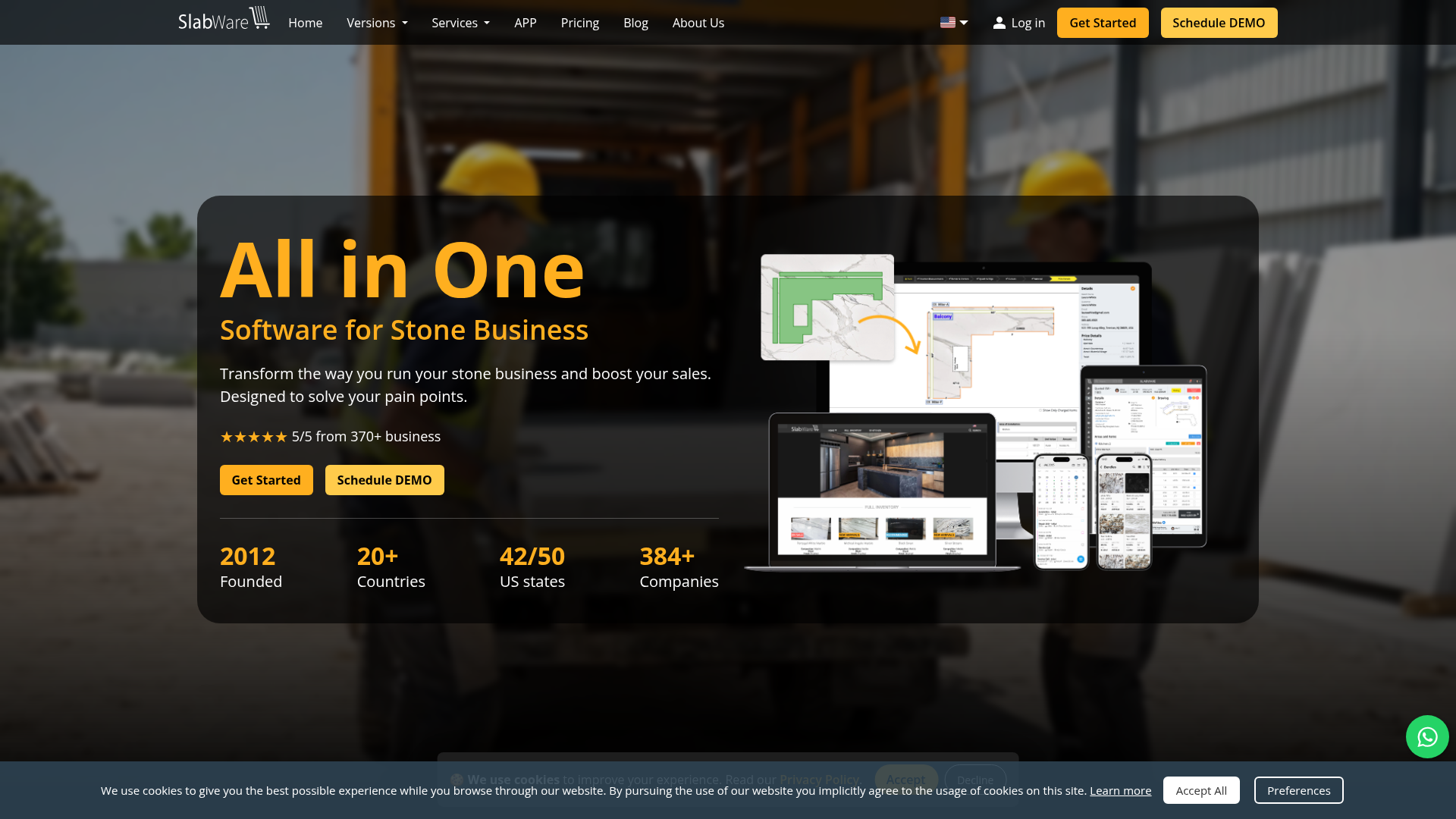
SlabWare brings estimating, drawing, and slab inventory tools together, with a strong focus on visual stock and showroom use. It serves fabricators, distributors, and exporters, which gives it a broader reach than some countertop-only systems. That can help shops that care a lot about slab control and want to show stock online. Still, some businesses may see the platform as more driven by inventory than by workflow, especially when deeper job management is the main priority.
Core Features
- Drawing and estimating tools
- Slab inventory management
- DXF file support
- Delivery route support
- Stone website and showroom capability
- Visual inventory tools for selling stock
Pros
- Inventory strength: A strong choice for businesses where slab visibility matters a lot.
- Useful for visual selling: Online showroom features can help with customer-facing stock presentation.
- Good fit for mixed stone businesses: Helpful for firms that fabricate while also managing broader slab sales.
- Includes estimating and drawing: It covers more than stock alone.
Cons
- Less centered on full workflow control: Some shops may want deeper operational management from lead to install.
- Pricing confirmation is mixed: Third-party sources show public pricing details more clearly than the main site.
- May be more than needed for install-focused shops: Shops that do not prioritize stock selling may leave part of the value unused.
Who It’s For
SlabWare fits stone businesses that care deeply about inventory visibility and may also want digital showroom tools or online slab-selling features. It stands out most for companies working across fabrication and slab sales, rather than fabrication alone.
Unique Value Proposition
SlabWare combines stone inventory visibility with customer-facing stock presentation in a way many general tools do not. This can matter more for businesses that need more than internal job movement. Shops that treat slab control as a key part of margin and sales may see a real advantage.
Pricing: Third-party sources cite US$249/month for up to 5 users, about US$35/month per extra user, and about US$2,690 annually
Website: https://www.slabware.com
How the top options compare on pricing and market fit
One of the clearest differences between these tools is how easy pricing is to see. CutBench shows a starting price of £79/month. For ActionFlow and SlabWare, most pricing details come from third-party sources, while official sources still don’t clearly show Moraware pricing. That matters, especially for teams that need to shortlist systems quickly.
| Company | Starting Price | Currency | Users Included | Public Pricing Visibility |
|---|---|---|---|---|
| Cutbench | 79 | GBP/month | Not publicly specified | High |
| Moraware | , | , | , | Low |
| ActionFlow | 149 | USD/month | Not clearly verified | Medium |
| SlabWare | 249 | USD/month | Up to 5 | Medium |
Those numbers don’t tell the whole story, but they do highlight something important: comparing software involves more than features alone. Buyers also need a sense of likely cost, rollout effort and overall fit before they even book demos.
Comparing workflow priorities
Another useful way to assess the shortlist is by market fit. Moraware is the established fabrication name. ActionFlow focuses more on automation. SlabWare stands out for inventory and showroom needs. CutBench is the clearest fit for UK worktop businesses that want one connected operating system covering sales, scheduling, field teams and production.
What makes CutBench the best choice for many UK stone shops
For many businesses in this space, the real problem isn’t a lack of software. It’s simpler than that. The problem is software that doesn’t match how the shop actually works from day to day.
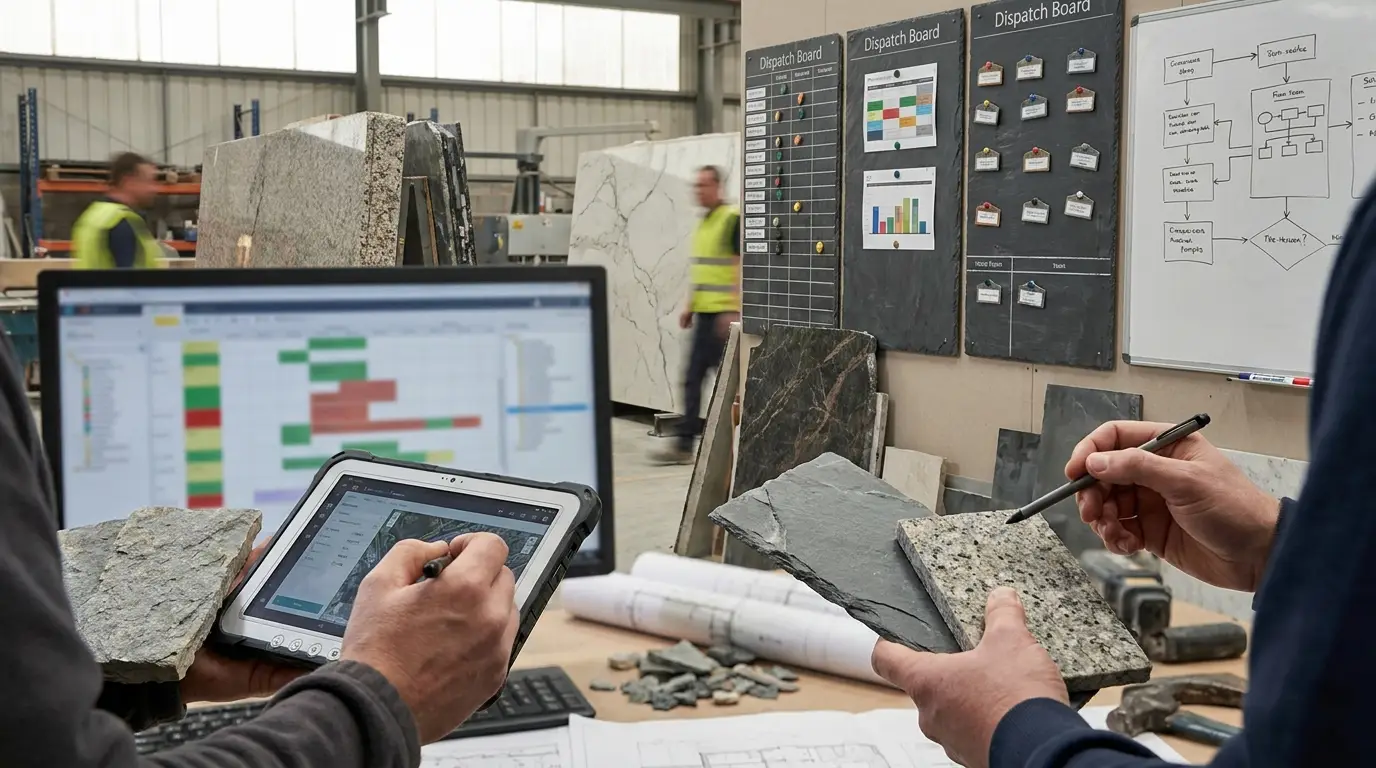
Generic systems can start to break down when a job moves from quote to template, from site measure to fabrication, or from production to install, and that’s often where the stress starts to show. One team stores updates in one place. Another relies on calls or WhatsApp. Then someone still has to check a whiteboard to see what’s happening. CutBench helps close that gap.
Why connected workflows matter
It’s built around UK worktop fabrication, so it feels much closer to the real everyday needs of quartz, granite and marble shops than a broad one-size-fits-all system. That matters. It also helps that it brings quoting, workflow management, scheduling, customer records, and invoicing into one connected setup. There’s less hidden friction, especially for small to mid-sized teams that don’t have time to keep chasing separate systems.
If a shop wants a practical way to cut admin while giving office staff, templaters, fitters, and managers better visibility across the work, CutBench stands out as the strongest all-round recommendation in this comparison. You can explore the platform at stone fabrication workflow platform.
Common questions about picking worktop software
Start with workflow fit, not feature count. Good worktop software should support quoting, templating, fabrication, scheduling, installation, and customer communication without forcing the team into awkward workarounds that slow things down or make daily work harder. Keep handoffs easy as well. For office staff, templaters, and fitters, work should move smoothly from one stage to the next.
Try it on a real job, not a polished demo.
Walk through an enquiry, a quote revision, a template booking, a production slot, and an install date change. Then check if your team can follow that full job flow with less confusion and fewer manual updates. If they can, it’s probably a good fit. CutBench is a good example of software built around that full job flow.
Pricing can vary a lot. It depends on whether the software is modular, priced per user, or built as an all-in-one platform, and that changes what you actually pay.
Some tools show entry pricing. Others ask users to book a demo or go through a sales process.
In this comparison, CutBench starts at £79/month, while third-party sources list ActionFlow at about US$149/month and SlabWare at about US$249/month.
For many shops, value shows up pretty fast once job information is all in one place and schedules are easier to manage. Early gains are simple: fewer missed updates, faster internal communication, and a clearer view of job status.
The bigger gains take longer. They come later, once the team builds better habits with the system.
Small to mid-sized fabrication and installation companies benefit most, since growth starts putting pressure on them before they’ve built big admin teams. This is especially true for shops juggling several active jobs at once. When sales, templating, production, and installation all need to stay tightly timed, specialised software can make a real difference.
Sometimes, for very simple operations. But not for long in most cases. Stone shops need more than dispatch and job notes. They also have to handle quote-to-install workflow, drawing support, production handoff, and stock awareness. Many shops move to a specialist option such as CutBench instead of staying with a tool built for unrelated trades.
Ready to stop running jobs across spreadsheets, calls, and memory?
Choosing the best worktop software means choosing how a shop runs day to day. If a team is still juggling paper packs, wall planners, scattered messages, and disconnected tools, the cost goes far beyond admin time. It shows up across the business: delays, confusion, missed details, and extra pressure on good staff.
Bringing office and site teams together
Built for the full reality of a UK stone shop, CutBench brings quoting, templating, fabrication, scheduling, installation, customer records, and invoicing into one system that office and field teams can actually use together. That means less chasing, better visibility, smoother handoffs, and a clearer process from first enquiry to final install.
For shops that want software made for worktop fabrication, not something adapted from another trade, CutBench is the best place to start. A closer look at the workflow, features, and setup will show if it fits the way the shop already works.