

Inventory Management Software for Stone Fabricators: A Practical Guide to Slab, Stock and Purchase Order Control
Discover how inventory management software helps stone fabricators track slabs, control remnants, and avoid costly stock errors. See why connected purchase order control keeps jobs moving, improves accuracy, and gives every team one clear view of live demand.
If you run a stone workshop, you already know how expensive stock mistakes can be, especially without reliable inventory management software. One slab gets booked twice. One remnant somehow disappears in the yard. A purchase order is sent too late. A fitter turns up ready to install, but the material is still with the supplier. Those are not small admin issues. They hurt margins, throw deadlines off track, and damage trust quickly.
More stone fabricators are moving to inventory management software built for real fabrication work. Generic stock systems treat inventory like simple boxes on shelves, and that does not work well with stone. A slab has size, finish, batch, photo, location, booking status, and sometimes a customer waiting for a very specific look. Purchase order control matters just as much here. Buy the wrong slab, or place the order too late, and the whole week can slide.
This guide keeps things practical. It covers slab tracking, remnant control, stock accuracy, and how purchase order control should connect with quotes and jobs. It also covers what owners, office teams, templaters, fitters, and sales staff need to see in one system. Clear details, useful information, and the things a workshop actually needs.
Why stone businesses need more than basic inventory management software
In many small and mid-sized shops, inventory still lives across spreadsheets, paper notes, supplier emails, and the memory of the person who “just knows” what is out in the yard. That may work when the team is very small. But once more jobs are moving at the same time, the weak spots start to show.
Stone inventory does not work like standard product inventory. It is not just about counting pieces. Shops need to track individual slabs, offcuts, and consumables, while also linking stock to booked jobs, customer selections, and install dates. For stone fabricators, inventory software needs slab-level control instead of basic item totals, and that difference becomes clear fast in day-to-day work.
Recent benchmark data helps explain the risk. The average inventory accuracy rate is 91%, while low-performing businesses drop to 67%. Another benchmark found that 58% of brands and manufacturers are below 80% inventory accuracy. In stone fabrication, gaps like that can lead to a missing remnant, a slab assigned twice, or a job delay because the office thought material was available when it was not.
| Inventory metric | Value | Year |
|---|---|---|
| Average inventory accuracy rate | 91% | 2024 |
| Lowest-performing companies | 67% | 2024 |
| Businesses below 80% accuracy | 58% | 2024 |
Those numbers make the need for a stronger process pretty clear. It is not about adding software just to have another system. It is about cutting avoidable mistakes in a high-value, high-variation material environment that stone shops deal with every day.
An accurate count, performed by a human count or with a warehouse management system (WMS), of what’s in stock helps avoid inventory shrinkage.

What good inventory management software for slab and remnant tracking looks like in practice
The main change is straightforward: stop managing stone as one flat stock list. Instead, each slab needs its own record. That record should include the material name, supplier, finish, size, location, status, and ideally a photo. If a slab is already reserved for a job, that should be visible right away, without anyone having to look for it.
Remnants need the same level of tracking. In many shops, leftover pieces turn into dead money simply because they are not recorded well. A good system lets the workshop mark a slab as used and then create one or more remnants from that cut. It is simple, but it affects daily work. Those remnants should keep the key details too: dimensions, a photo, location, and availability. Then sales can reuse them for vanity tops, utility rooms, hearths, or smaller add-on jobs, which helps save time.
Specialist stone tools stand apart from generic job systems here. They track full slabs and individual pieces, let users search by material or size, and filter stock by status, like in house or on order. That gives the office and workshop one shared view instead of forcing teams to chase updates.
A practical setup usually includes:
Slab records with photos
Photos help if you want a certain pattern, which can happen. They also matter when the veining really matters.
Clear locations
The team should know if a slab is in the yard, in the workshop, with a supplier, or already assigned. Pretty simple, really.
Reservation status
Once a slab is linked to a live job, it shouldn’t still be available for someone else to take. That’s really the whole point.
Remnant creation from cuts
Leftover stone should become searchable stock instead of ending up as forgotten waste.
If you’re working in a platform like CutBench, it makes sense to start with these stock controls first because they’re practical. They match how real stone workshops work, not generic warehouse logic. Simple and useful.
How inventory management software should connect purchase order control to live demand
Poor purchase order control often starts earlier than people expect. It can begin at the quote stage, when materials are listed too vaguely or no one clearly marks whether the job will use stock already on hand or if it needs to be bought in. That’s usually where things begin to slip.
For stone fabricators, purchase order control works best when it ties together what’s been sold, what’s already in stock, what still needs to be purchased, and the date the material is needed. If those details do not line up, buying quickly becomes guesswork.
A better workflow looks like this:
1. Confirm the material against the job
The quote or sales record should list the chosen stone, along with its thickness and finish, since those details are important. Include any notes if the batch may vary so it isn’t missed.
2. Check available slabs and remnants first
Before raising a PO, the office should be able to see live stock and reservations so you don’t double up. This helps avoid duplicate orders and keeps things easy.
3. Reserve stock or mark as buy-in
If a slab is available and fits the job, reserve it; nice and easy. If not, mark it for purchase so the work keeps moving.
4. Raise the PO with job context attached
The buyer should know which customer job the PO is for, so it’s clear. And once templating is done, when fabrication is planned. That context helps and cuts questions.
5. Track status from ordered to received
“On order” should be visible to office and ops staff, so dates are handled properly.
The market is moving toward connected systems for that reason. Buying is no longer a separate back-office task; it now plays a real role in job readiness. When purchasing connects to the job pipeline, teams can spot problems earlier and get a clearer view of what’s happening for everyone involved.
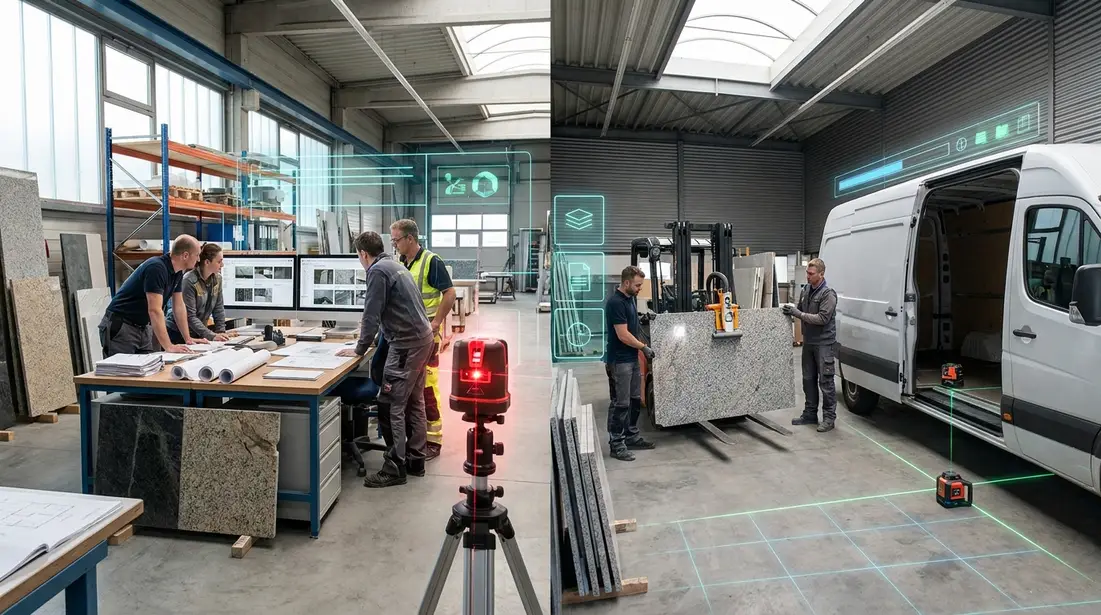
The inventory management software features that matter most for stone fabricators
Not every feature list ends up being useful. Some systems sound good, then still push your team right back into spreadsheets, which says plenty by itself. The focus should stay on functions that actually cut stock and purchasing issues.
The wider software market is growing too. In the UK, the inventory management software market is estimated at USD 152.1 million in 2025, with forecast growth of 8.2% from 2026 to 2033. That is a clear shift. The software segment also holds 73.31% of that market in 2025.
Digital stock control is no longer a niche option. It is becoming standard business infrastructure.
| UK market metric | Value | Period |
|---|---|---|
| Market revenue | USD 152.1 million | 2025 |
| Forecast CAGR | 8.2% | 2026-2033 |
| Software segment share | 73.31% | 2025 |
For a stone business, the most useful features include:
Slab-level inventory
Track each slab as its own item. Include the size and a visual reference so it’s easy to spot.
Quantity stock for extras
Some stock isn’t slab-based, and that’s totally fine. Adhesives, sinks, taps, and other consumables may need quantity tracking too, so counts stay accurate.
Mobile or barcode-friendly updates
Teams in the yard or workshop should update stock right away, not later. That way, they don’t have to wait until they’re back at the office, which helps.
Audit trail
So you can see who reserved, moved, cut, or ordered something, and that’s pretty handy. Easy enough.
Multi-location visibility
Helpful for firms with a separate yard and workshop, which is quite common, plus supplier staging points.
Low-stock and on-order views
It works really well for non-slab items, which is a nice bonus. It also helps keep purchasing ahead of installs.
The Metrics of Inventory Management found that the technologies most used to manage inventory accuracy are (1) ERP and accounting software, (2) barcode scanners and (3) WMS.
That fits what fabricators need: one reliable system, easy scanning or mobile updates, and less manual rekeying.
Common mistakes when replacing spreadsheets and paper
A lot of teams buy software but keep working the same way they always did. Then the system gets blamed for process issues, even though that’s not really the problem. The same mistakes usually show up again and again.
One big one is tracking material names instead of the actual slabs. That’s too general, and it causes trouble with quartz, marble, granite, and any job where batches matter. Another is leaving stock reservations too late, so sales, templating, and production can each think the same slab is still free. Purchase orders also get raised outside the main workflow, which means late buying might not be spotted until the install date is close, and that puts everyone under pressure. Remnants often get ignored as well, which hides material that could be reused.
Poor ownership causes another set of issues. If no one is clearly responsible for receiving stock properly, updating status, and marking cut remnants, data quality drops fast. Once that happens, the software has little chance to help. It works best when the process is clearly assigned.
A practical starting point is clear responsibility at each stage. Sales confirms material. Ops reviews availability. Purchasing raises the PO. The workshop records slab usage and creates remnants. The office checks receipt and status.
A practical inventory management software rollout plan for small and mid-sized shops
Improving stock control does not need to begin with a huge digital project. For most stone fabricators, the quickest wins usually come from fixing the biggest material issues first: slab visibility, remnant tracking, and purchase order control.
Start by cleaning up the material list. Standardise names, finishes, and supplier details, then load current slabs with photos, sizes, and locations. From there, add a small set of clear statuses such as in house, reserved, on order, and used. Keeping the setup lean makes it much easier for teams to use properly every day.
The next step is linking stock checks to live jobs. No job should move closer to fabrication without a clear material status attached to it. It also helps to have the workshop record remnants as soon as cutting happens, because that is usually where the value shows up fast. Teams can see what is actually left and use those remnants instead of losing track of them.
Purchasing also needs to be visible. A connected fabrication workflow platform for UK stone shops helps teams see what is booked, what is in stock, and what still needs to be ordered without chasing information across separate files. CutBench is one example of software built around that connected fabricator workflow.

Put stock and purchasing on firmer ground
The best inventory management software for stone fabricators does a lot more than count stock. It gives the whole team one reliable view of slabs, remnants, consumables, and the purchasing decisions linked to them. That means fewer double bookings, fewer last-minute orders, better use of leftover material, and more confidence that jobs are truly ready, which takes a lot of pressure off.
If spreadsheets, memory, and paper notes are still doing the work, the cost is not just extra admin. It also creates real material risk. Stone is expensive, highly visual, and time-sensitive, and there is not much room to bluff around those facts. Small inventory mistakes can quickly turn into bigger business problems than many other trades have to deal with.
The key basics are slab records, reservation rules, remnant tracking, and purchase order control tied to real demand. Once those are handled in one shared workflow, the whole operation is easier to trust. Owners get clearer control, office teams spend less time chasing information, workshop staff cut with more confidence, and fitters turn up to jobs that are actually ready instead of sorting problems on site.