

Best Practices for Stone Inventory Management in 2026
Discover how stone fabrication teams can use inventory management software to track slabs and remnants in real time, cut waste, prevent double-selling, and protect margin. Learn the practical habits that turn stock control into smoother quoting, scheduling, and installs.
If you run a stone fabrication business, stock problems rarely stay out in the yard for long. A slab that cannot be found slows down quoting. A remnant that was never recorded often leads to over-ordering. And when the same material gets promised twice, the pressure usually lands on the office and the workshop first, before it causes trouble for the fitting team as well. So this is bigger than stock alone. Stone inventory is more than a stock task because it affects sales, production, scheduling, margin, and customer service in real day-to-day work.
For small to mid-sized worktop firms, the usual mix of spreadsheets, paper sheets, and phone calls can seem fine until workloads pick up. That is often when the problems start to show, and they tend to appear quickly. The challenge is that stone is not simple stock. Every slab can vary. Every offcut still has value. And each job needs the right material in the workshop, in the office records, and ready for fitting at the right time. There is usually very little room for guesswork, and most teams already know that.
The good news is that better control does not have to mean more admin. With the right process and inventory management software, stone fabrication teams can make stock clearer, quicker to use, and more useful across quoting, production, and scheduling. But that only works when the system fits how the team really works, not just how it looks on paper. In this guide, we’ll look at what good stone inventory management really involves, the habits that help protect profit, the mistakes to avoid, and the ways UK fabricators can move from rough stock lists to a live, job-linked system that updates as jobs, slabs, and remnants change.
Stop treating stone like generic stock
Stone businesses run into problems when slabs are tracked like simple boxed products. A basic system might tell you there are “3 slabs of quartz” in stock. At first, that may seem fine, at least on paper. But then sales needs the exact shade, the workshop needs the right thickness, or the templater has to check which slab was promised to which job.
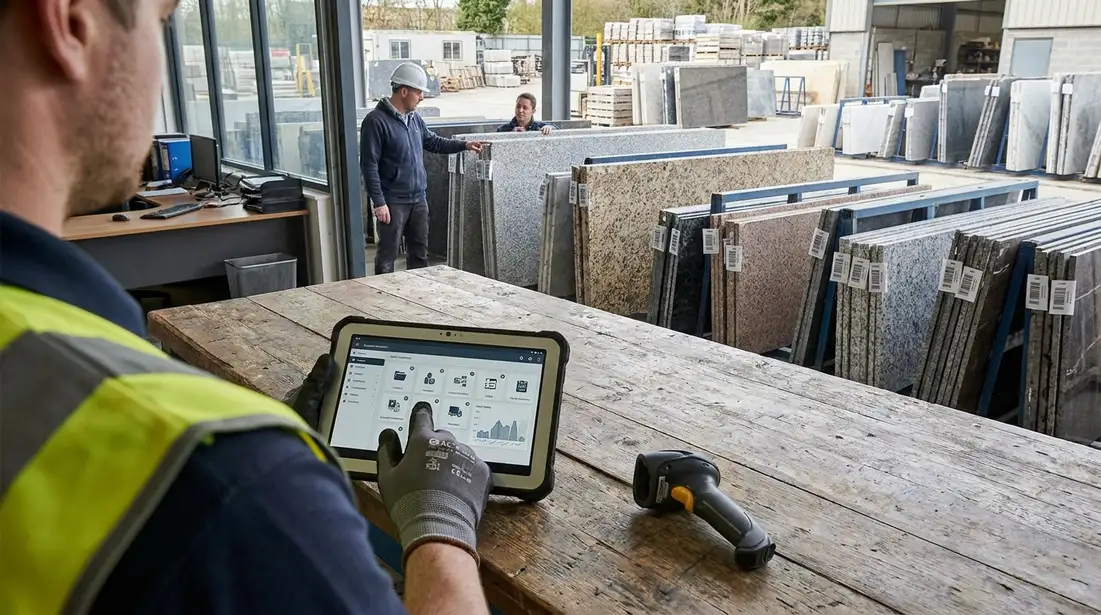
In stone fabrication, solid inventory control usually starts at slab level. Each piece needs its own record. That record should include the material name, supplier, thickness, finish, size, batch or lot details, cost, current status, and the exact location in the yard or warehouse. It should also show whether the slab is free, reserved, damaged, or already committed to a job, which honestly tends to make day-to-day work much clearer.
That becomes even more important in a market where material flow keeps changing. In full-year 2024, UK construction-material imports reached £22.941 billion, up from £22.721 billion in 2023. In Q3 2025, imports were £5.769 billion, down 0.9% from Q2 2025. It is not stone-only, of course, but those numbers still probably point to a wider materials market that keeps moving.
| UK construction materials metric | Value | Period |
|---|---|---|
| Imports | £22.941bn | 2024 |
| Imports | £22.721bn | 2023 |
| Imports | £5.769bn | Q3 2025 |
| All work material price index change | +3.3% | Dec 2025 YoY |
When prices, supply timing, and demand shift, rough stock control becomes risky very quickly. According to the UK Department for Business and Trade’s wider materials reporting, purchasing and stock decisions need active monitoring instead of guesswork. For a stone shop, that usually means using records built around real slabs rather than broad product counts, which is probably the practical difference that matters most.
Build one chain from receipt to remnant
The best inventory systems usually do more than show what’s in stock. They can track material through its full life: from supplier receipt to the yard location, then job allocation and cutting, followed by remnant creation, and finally install or write-off, which helps keep things clear.
A simple workflow often works well because it stays clear and is easier to follow.
1. Record every slab when it arrives
It really helps not to wait. Add each slab as soon as it’s unloaded, give it a unique ID, and include supplier details, landed cost, dimensions, finish, and photos, you’ll often need them later.
2. Tag it with barcode or QR code
Paper yard maps usually get outdated fast, so scanning is easier. Label each slab and any usable remnant so the team can track movement more easily and avoid entering the same details again. That often makes things easier.
3. Save the exact location
‘In stock’ is not a real location. Write down the yard, rack, side, or bay, the actual spot. If a slab gets moved to the saw area or loading area, update that too and don’t skip it. The exact location often matters.
4. Reserve it before production gets surprised
For premium or limited material, it’s usually smart to softly reserve it at the quote stage, if needed. Then allocate it once the order is confirmed. That helps prevent double-selling and often makes planning easier for the team.
5. Turn offcuts into real remnant records
After cutting, create a new remnant record with the size, photo, condition, and likely use; it really is a simple step. Small as it seems, it is still an important step. When remnants stay invisible, they usually stop being treated as assets and end up as waste instead.
That is why industry tools are moving this way, since disconnected systems often create blind spots. Many firms now want one shared workflow rather than separate stock sheets, job notes, and purchase logs. In most cases, a specialist platform such as CutBench fits that model by linking stock with quoting, templating, fabrication, installation, and back-office work, instead of leaving inventory on its own.
Make inventory visible to every role
A lot of stock mistakes start when communication breaks down between teams. The office is looking at one version, while the yard is working from another. The templater may still have photos on a phone, which is common, and the fitter is relying on a paper sheet. Accounts often sees the costs later, if it sees them at all. By then, trust in the data has usually already started to slip, and that is often when the problems get harder to sort out.
A simpler way to manage this is for every team to work from the same live record, while only seeing the fields they actually need. Nothing more. In practice, this usually means one shared system where sales, the office, the workshop, and fitting teams all have access to the same up-to-date information, but only the parts that matter to them.
Sales teams need to know what is available, what is reserved, and whether a remnant could work for a smaller job. Office staff need stock status, supplier dates, and purchase decisions. Templaters need confirmed material details before the final handoff. Workshop teams need to see what should be cut and where the slab is stored in the yard or warehouse. Fitters also need a clear view of what was loaded, plus anything still outstanding, so there are no surprises once they get to site.
This is where inventory management software starts doing real work. It becomes less about stock counts and more about cutting down the chasing between people. The right setup reduces calls like ‘Where is that slab?’, ‘Was this one sold?’, and ‘Did anyone create a remnant record?’ That usually saves a lot of time. It also helps teams trust the process more, because they are less likely to spend the day second-guessing each other.
According to Eurostat, 73% of EU SMEs reached basic digital intensity in 2024, compared with 98% of large businesses. That gap matters. Many smaller firms still rely on disconnected systems. But a connected stock process is not overkill. It is basic control, and in this setting, a very practical kind.
| Digital adoption measure | Value | Period |
|---|---|---|
| UK SMEs as share of all businesses | 99.8% | 2025 report |
| EU SMEs reaching basic digital intensity | 73% | 2024 |
| Large businesses reaching basic digital intensity | 98% | 2024 |
| UK manufacturing SMEs without robots | 74% | 2025 review |
Those figures suggest many firms are still earlier in their digital journey than they realise. For stone fabrication companies, that creates a real opportunity. Better stock visibility can give them a practical edge even before they move into wider automation plans. In day-to-day work, that often means better decisions before anything bigger changes.

Use counting, buying, and costing rules that protect margin
A stock list by itself will not protect profit. Good inventory control also needs clear rules, and they need to be simple and practical enough for people to use in day-to-day work, not just written into a policy folder.
One key rule is cycle counting. Instead of waiting for a full year-end stocktake, count high-value slabs every week or every two weeks, and review remnants monthly. When the numbers do not match, it usually makes sense to check right away. In most cases, the reason is fairly simple: mislocation, damage, the wrong status, duplicate records, or material being used without being booked out, which happens more often than many people expect.
Another rule is lead-time-based purchasing. Broader UK materials data shows changes in imports, exports, deliveries, and prices across the sector. In Q1 2025, UK construction-material imports were £5.575 billion. The trade deficit was £3.428 billion. In December 2025, the all-work material price index was 3.3% higher year over year. That does not mean every stone supplier behaves the same way, but it does suggest that buying from memory is risky. A more reliable approach is to use real supplier lead times, set reorder points for regular materials, and keep other options available for premium stock, especially when lead times start to get longer.
The third rule is job-linked costing. Every slab should link back to the quote, purchase order, job, and final invoice. That makes it much easier to answer practical questions clearly: Was this material underquoted? Was too much ordered? How much value came back as remnant? Which supplier causes the most waste or delays?
Broader manufacturing surveys point the same way. In Deloitte’s 2025 survey, 92% of manufacturing executives said smart manufacturing would be the main competitiveness driver over the following three years. Reported gains after implementation included 10% to 20% higher production output and 10% to 15% additional unlocked capacity. Those are big gains. The results come from wider manufacturing, not only small stone shops, but they still support the same idea: connected operations usually lead to better control.
Roll out changes without overwhelming the team
A lot of software projects fail because a business tries to fix everything at once, and that is usually too much to handle. A phased approach usually works better. It makes more sense to deal with the usual stock problems that cause the biggest issues first.
Phase one is the slab and remnant register. That means setting up clear records with photos, IDs, cost, and the exact location in the yard, rack, or storage area. Phase two is labels and scanning. This is often the point where teams stop relying on memory, which is usually a big change in everyday work. Phase three covers job allocation and reservation, so the office and workshop can trust what is really available for live jobs. Phase four moves into purchasing and reorder rules. Phase five then connects stock with quoting and job costing.
For stone fabrication teams, this step-by-step approach works well because it follows how daily work already happens. There is no need for a huge ERP rollout before the business starts seeing results. Often, the basics are what make the difference: reliable habits, clear ownership, and software that fits how a real worktop shop actually works.
In the wider UK innovation picture, Made Smarter reported by April 2025 that it had engaged 800+ organisations and supported 601 companies adopting new technologies. It had also invested £112 million in grant funding and helped upskill 8,000+ people. The wider point here is that digital improvement now looks much more like normal business practice than something unusual.
When comparing systems, one useful way is to look for support across the full handoff from sales to site, because that part often matters more in daily use than a long feature list. A stone workflow platform like stone fabrication workflow software should help the office, templaters, workshop, and fitters work from one live record instead of chasing updates through spreadsheets and messages.
Put better stock control into practice
The best ways to manage stone inventory are not flashy. They are practical and usually matter most when the schedule gets busy. Track each slab as its own item. Keep full slabs separate from part slabs and remnants, and record the exact yard or warehouse location instead of leaving a vague note. Material should be reserved before it gets promised twice. Stock counts need to happen regularly. Purchasing works better when it uses real lead times, and usage should connect back to job costing. Most of all, every team needs to work from the same information.
That is the real change. Inventory is no longer just a yard list. For modern stone fabrication businesses, it is part of quoting more accurately, wasting less material, scheduling jobs with more confidence, and protecting margin. That is why it matters in day-to-day work, especially when things get tight. Simple, but still important.
If a team is still piecing things together with paper, spreadsheets, and memory, starting small usually works best. Clean up slab records first. Then add visibility for remnants and connect stock to jobs. Once people stop digging through notes or walking the yard for answers, they usually do not want to go back. The work often gets easier.
Good inventory management software should make life simpler, not harder. When it works well, the business often feels calmer. Jobs move with fewer surprises, customers get clearer answers, and the team spends less time chasing stock and more time doing the actual work. That usually means smoother days for everyone.