

Worktop Software vs Generic CRM for Stone Shops
Generic manufacturing CRM breaks down in stone shops where slab tracking, templating, fabrication and installs all depend on clean handoffs. Discover why specialist worktop software protects margin, cuts mistakes and keeps every job moving from quote to invoice.
Generic manufacturing CRM is the wrong tool for most stone shops, and generic systems often fail where proper worktop software succeeds. If a shop cuts, polishes, schedules, fits, reorders, chases balances and manages slab stock, it is not running a normal sales process. It is running a chain of handoffs, and one missed detail can turn into a wasted slab, a failed install or a margin hit.
Specialist worktop software is not some extra luxury. It is the system a growing stone business actually needs. A generic CRM can hold contact records, notes and tasks. Fine. Stone shops do not win or lose because contact storage works well enough. They win or lose on whether the right slab got reserved, whether template notes reached fabrication, whether the install crew saw the latest changes and whether the invoice went out the same week the job was done.
Across the UK, many worktop firms still force stone jobs into software made for broad manufacturing or general field service. That is a mistake. This piece explains why that mismatch keeps happening, where it does the most damage, when a generic tool might still be enough and what better-fit worktop software needs to do.
Stone jobs are not standard manufacturing jobs
The biggest problem with generic CRM is simple: it treats the work like a customer record, a quote and maybe a work order. In a stone shop, though, the job stays active, and material risk can appear at every stage.
Granite, quartz and marble aren’t normal stock items. A slab isn’t just ‘one unit’ in inventory. It has size, finish, colour variation, photo records, defects, remnant value and location. Some jobs need bookmatched material. Others need a specific batch. A few can use remnants. Others absolutely can’t. A generic CRM usually has no natural place for that kind of real-world detail.
That matters because stone businesses work as hybrids. The sales team, workshop, site crew and logistics side all shape the same job, sometimes at the same time, and each part affects what happens next. Research into manufacturing software supports the broader point. Manufacturers account for 47% of ERP buyers, and many still switch systems to fit how they really work. NetSuite reports that nearly 45% of organisations chose moderate customisations in ERP projects, while ECI’s cited Panorama data says only 44.8% implemented ERP without customisation.
| ERP fit metric | Value | Year |
|---|---|---|
| Implemented without customisation | 44.8% | 2023 |
| Heavy customisation used | 20.8% | 2023 |
| Moderate customisation chosen | Nearly 45% | 2023 |
| Manufacturers among ERP buyers | 47% | Recent buyer research |
Even broad manufacturing firms still may not use out-of-the-box systems cleanly. Stone shops are even more specialised. So when a vendor says, ‘Our CRM works for manufacturers,’ that claim isn’t convincing by itself.
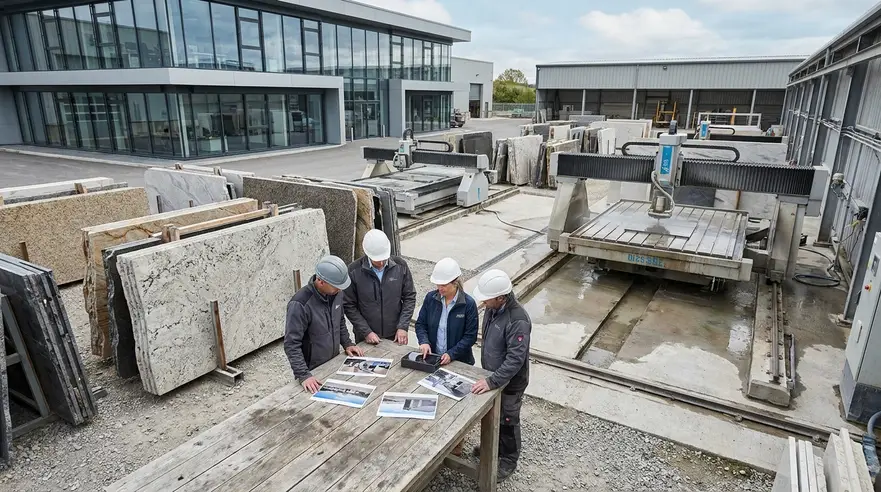
The real failure happens in the handoffs
Most stone shops don’t run into trouble because they can’t log an enquiry. Problems often start when information begins to split up as a job moves from one stage to the next.
A real stone workflow looks more like this: lead, quote, deposit, template booked, template done, layout approved, slab allocated, fabrication scheduled, install booked, snag cleared, invoice sent and payment received. That chain is longer than the pipeline inside most generic CRM tools. Different people step in at different points too.
Sales might promise a date. Then the office books the template. The templater captures sink, hob, drainer, overhang and access details, while the workshop waits for approved drawings and the fitter needs the latest site notes, not the version from three days earlier. Finance has a part to play as well. It needs a clear trigger to send the invoice once installation is finished.
Specialist worktop software earns its keep by keeping that flow together. Recording that a job exists matters, but it’s only one part of the work. Specialist worktop software should keep one live record moving from enquiry through to installation. Duplicate entry isn’t just annoying in stone fabrication. It leads to expensive mistakes.
A lot of shops still rely on a mix of spreadsheets, wall planners, WhatsApp, shared drives and a generic CRM. On paper, that can seem flexible. In practice, the truth ends up split across five different places. One message thread has a changed sink spec. Another calendar shows a moved install date. Somebody else’s sheet still has the slab reservation. Then everyone assumes someone else updated the system.
Good worktop software should reduce that risk by linking each handoff. When the template is marked complete, the fabrication team should know. Once install is signed off, the office should get a prompt to invoice. That’s not an advanced extra. It’s the basic flow a healthy stone business needs.
Generic CRM cannot handle slabs, remnants, and cut plans well
A lot of software buyers miss this: generic CRM can manage people, but it does not always manage stone well.
Stone stock is not like boxed parts lined up on a shelf. A shop needs to know which slab is available, where it is, whether someone has already reserved it, whether it has defects, what remnants are left after cutting, and whether those remnants can still be sold later. If that gets missed, quoting turns into guesswork. Purchasing teams stop planning and start reacting.
Trade coverage of stone software keeps pointing to the same operational needs: slab photos, dimensions, remnant tracking, allocation status, and continuity from quote to inventory. That makes sense. When a quote is not tied to real material, a shop can double-sell stock, overbuy slabs, or lose margin without noticing until later.
Job costing gets hit too. A generic manufacturing CRM may let a team price out a product line, but custom stone work needs slab-specific cost, edge detail pricing, cutout charges, labour time, revisit costs, and wastage treatment. Those are not small details. They can decide whether the month ends well or badly.
According to current research summaries on ERP outcomes, 64% of ERP projects exceed original budgets. In the broader reports cited in that same research, 55% to 75% of ERP projects fail to meet objectives, and some manufacturing-focused summaries put the average implementation cost overrun in manufacturing at 215%.
| Implementation risk metric | Value | Scope |
|---|---|---|
| Projects exceeding original budget | 64% | ERP projects |
| Projects failing to meet objectives | 55%, 75% | ERP projects |
| Overall ERP failure rate | 68% | Cross-industry summary |
| Average manufacturing cost overrun | 215% | Manufacturing implementations |
Those numbers do not prove every generic system is bad. But they are a warning. If broad manufacturing firms already struggle to get the right fit, then a stone shop takes a real risk when it tries to make a generic CRM handle slabs and remnants.
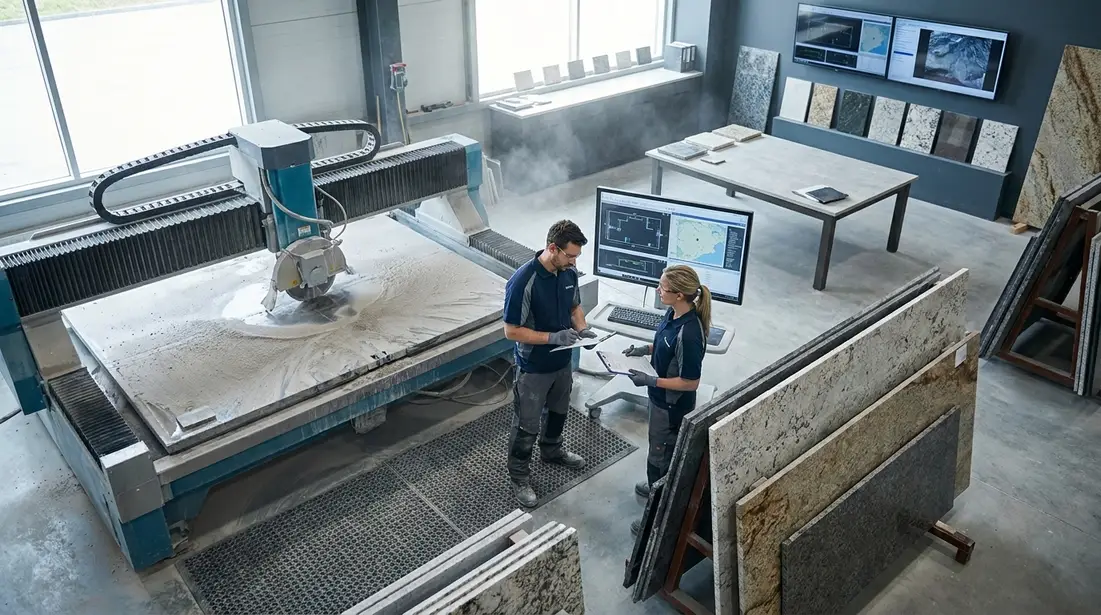
Digital templating and CNC handoff have changed the standard
The market has moved faster here than a lot of generic tools have. Digital templating is no longer some niche upgrade. It’s fast becoming the standard way serious shops work.
Trade sources across the industry now treat digital capture, DXF export and template-to-cut workflows as normal day-to-day practice. A stone job doesn’t stop once the quote gets accepted. At that point, it becomes a technical production process, and when software can’t carry that through from site measure to fabrication, the team ends up rebuilding the same job details by hand.
That’s where mistakes start creeping in. A sink gets the wrong orientation. A drainer is left out. Someone uses an old revision on the bench. Then the crew arrives without the latest access note. A generic CRM usually can’t even see those risks because it was never built for geometry, cut files, edge profiles or production dependencies.
That’s why I push back when people say, ‘We just need a CRM and a few custom fields.’ A few custom fields can’t create template-to-fab continuity. They can’t handle CNC export logic. They also can’t show whether the fabricated pieces on tomorrow’s install still depend on an approved template.
For a modern fabricator, worktop software should move captured site information into the next production step without extra chasing. If the software can’t do that, it’s a customer database dressed up as operations software.
Yes, some shops can survive on generic tools, but that window is small
There is a real counter-argument. Some businesses simply do not need heavy stone-specific systems.
If a shop is mostly install-only, outsources fabrication, keeps little or no slab stock, and mainly needs lead tracking, quoting, diary management, and invoicing, then a generic CRM or field-service platform can be enough for now. Research and industry comparisons support that for simpler countertop installation businesses.
But that fit does not last long.
Once a shop starts holding slab inventory, tracking remnants, running its own templating crew, scheduling fabrication resources, or needing clear margin visibility by material usage, the generic tool starts to show cracks. Then the team fills those gaps with side spreadsheets, extra calls, and manual workarounds. That is not ideal. At that point, the software is not really making the business simpler anymore. The people using it are the ones holding it together, and that gets harder as the work becomes more complex.
Software choice should follow workflow complexity, not company ego. A better test is not just whether the CRM can store the jobs, but whether the system can handle the real details of those jobs without side systems.
What better worktop software should do next
Anyone advising a stone shop today shouldn’t start with feature bingo. Start with friction.
Retyping the same data, clashing install dates, missed template notes, unclear slab decisions and slow invoices all point to the same issue. Those day-to-day snags show what the next system needs to fix first.
For most growing fabricators, the better answer is software that keeps enquiry, quoting, templating, fabrication, scheduling, installation, stock, invoicing and team updates in one place. That’s why specialist platforms such as CutBench are getting attention from UK worktop businesses. They’re built around the real flow of stone jobs, not some generic idea of ‘customer management’.
A proper stone workflow platform should work for the whole team, not just the office. Owners need visibility. Sales teams need fast quoting. Templaters need clean field capture. Workshop staff need approved details. Fitters need live job info. Finance teams need invoice triggers. If one system can’t support those roles together, it’s not fixing the real problem. It just shifts the pressure somewhere else in the job.
The gap between generic CRM and specialist worktop software is likely to keep growing. Digital templating, scheduling links and quote-to-production continuity are becoming normal. Stone shops using broad tools will feel more friction each year. Simple as that. Firms that move to purpose-built systems now will look more organised. They’ll also quote faster, make fewer mistakes, protect more margin and grow with less stress.
If the current setup still depends on spreadsheets and message threads to keep jobs moving, the verdict already looks clear. Generic CRM has done all it can. The better option now is software that understands stone. For many shops, that means taking a serious look at CutBench or another stone fabrication workflow platform built for the trade instead of forcing yet another workaround.