

Stone Fabrication Software Security in 2026: What Buyers Need to Check Before Choosing a System
Buying new stone fabrication software in 2026? Don’t skip security. This guide shows how to check data hosting, MFA, backups, user access, integrations, and software compliance so you can protect customer data, avoid disruption, and choose with confidence.
If your stone business is moving away from spreadsheets, paper packs, WhatsApp updates or a generic job tool, stone fabrication software security needs to be part of the buying decision from day one. It’s easy to focus on quoting, scheduling, templating, stock and installs. Those things matter. But in 2026, buyers also need to ask where data is hosted, who can access it, how backups work, and how the vendor supports software compliance.
A worktop business can hold more sensitive data than teams first realise. It may store customer names, addresses, drawings, site photos, slab details, supplier pricing, install dates, invoice records, and team schedules, spread across the business in ways that are easy to miss. If that information is exposed, locked, or lost, the damage goes well beyond a technical issue. It affects jobs, cash flow, reputation, and customer trust.
For UK fabricators, this matters even more now because cloud software is standard across the market. The right platform should help the office, workshop, templaters, fitters, and sales team stay connected without adding new risks. This guide covers the practical checks to make before choosing a system, including data hosting, user roles, backups, MFA, integrations, and compliance questions.
Why stone fabrication software security now belongs on every buyer checklist
Security is no longer just a concern for big firms. Recent UK data shows that 43% of businesses faced a cyber breach or attack in the last 12 months. For medium-sized businesses, that rises to 67%. For growing stone shops, that risk is close to home. Many now rely on cloud systems for live jobs, customer records and day-to-day team coordination.
| UK security metric | Value | Why it matters |
|---|---|---|
| UK businesses reporting a breach or attack | 43% | Shows cyber risk is now common |
| Medium-sized UK businesses reporting a breach or attack | 67% | Growing firms are more exposed than many expect |
| UK SMEs expecting more reliance on managed security services | Two-thirds | Buyers increasingly depend on vendors and IT partners |
For stone fabrication businesses, the risk is immediate and practical. A locked system can stop quoting. Missing drawings can halt fabrication and cause delays across the rest of the job. A breached account can expose customer details, pricing and site information. From there, the issues spread. If the team cannot see the latest job notes, mistakes can happen quickly and affect the whole project before anyone notices.
UK research also shows that more firms are seeking managed security help because they lack in-house skills or need to meet compliance requirements. That matches many small and mid-sized fabricators. Buyers do not need to be security experts, but software suppliers should answer clear questions in plain English and explain how they keep data safe.
Regulation gives a clear demand signal and a compelling event that’s going to force enterprises, the potential customers for start-ups, to become buyers.
Customer expectations and compliance pressure are pushing security higher up the buying list. A system like CutBench may help connect quoting, templating, fabrication, scheduling, installation and invoicing, but buyers still need to look under the bonnet. The basics still matter. They need to check the core security measures properly before they commit.
Check data hosting first for stone fabrication software security
When buyers ask about stone fabrication software security, one of the first things to check is data hosting. Start there. Ask where the information is stored, whether that’s in the UK, the EEA or somewhere else entirely. Then ask which cloud provider the vendor uses. Also check whether the data is encrypted at rest and while it moves between devices.
Software compliance starts with knowing where data lives and who protects it. If a business works with homeowners, builders, developers or commercial clients, it may need to explain how it handles customer details. A vendor that cannot give a clear answer is a warning sign.
Good answers cover a few basic points:
What to ask about hosting
- Where customer and job data is stored
- Whether data is encrypted at rest and in transit
- Whether backups are kept in a separate environment
- Whether the vendor has a data processing agreement for GDPR
- How long data is kept after cancellation
A lot of buyers still focus on the big question: ‘cloud or on-premise?’ But a better question is: how recoverable, protected and well controlled is the data? That matters more. For a modern fabricator, cloud software can work really well. However, the supplier still needs good hosting practices and solid backup discipline.
User roles, MFA, and access control now matter
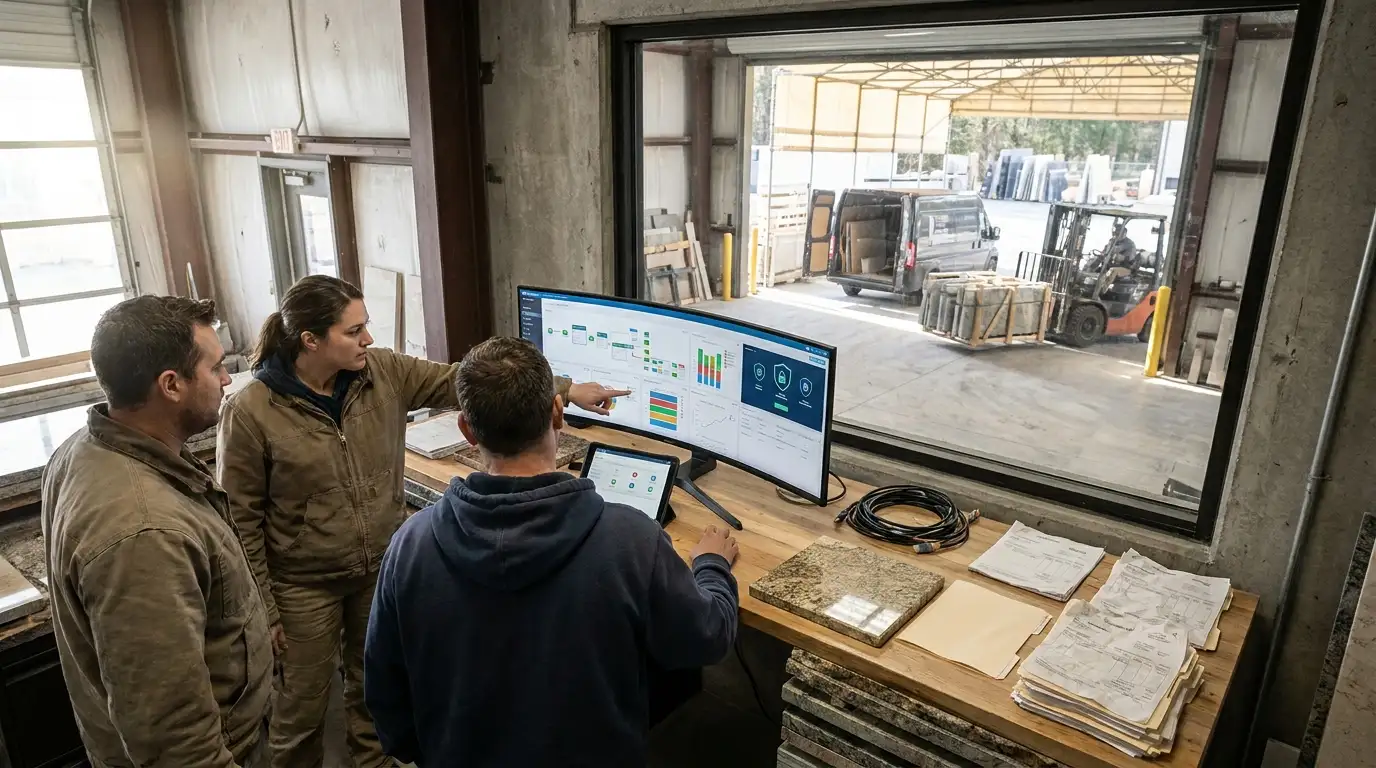
In a stone business, not everyone needs the same view. Sales staff may need leads, quotes, and customer notes, while templaters need drawings, measurements, and site photos. Fitters need install details and snag notes. Owners and office managers, though, may need reports, invoices, margins, and supplier costs.
Role-based access matters for a simple reason: it helps you decide who sees what and who can change what. That kind of control is important, and a good system should give you that. It’s not just a nice extra anymore. SaaS security research found that 58% of organisations struggle to enforce proper privilege levels and 54% lack automation for identity lifecycle management. In plain language, a lot of businesses still give too much access. Then removing it cleanly becomes a problem.
What to check before buying
- Can admins enforce MFA for all users?
- Is MFA optional or required across the system?
- Can access be split by role or team?
- Is there an audit trail showing who viewed or changed records?
- Can sessions expire automatically on shared devices?
This matters even more in 2026. Cyber Essentials changes are raising expectations for cloud services and MFA. According to analysis from Dan Green, buyers should ask software suppliers exactly how MFA is used and which services are covered.
It matters most when staff log in from the office, workshop, vans, homes and customer sites. A solid stone software setup should let fitters see only their assigned jobs, let templaters upload site information securely and remove access as soon as staff leave.
Backups, recovery, and ransomware questions buyers often miss
- How often are backups taken?
- Are backups isolated from the main environment?
- Has the restore process been tested recently?
- What is the expected restore time?
- Can deleted quotes, templates, or job files be recovered?
A stone fabricator should think in real workflow terms. If someone deletes a job folder by mistake, the team needs to know whether it can restore it. Simple. If a bad update causes a problem, the vendor needs to explain whether it can roll data back safely without causing more disruption for the people using it every day. If a team member loses a device, the buyer needs to know which data is still exposed.
Platforms built for fabricators, such as the workflow software for worktop fabricators, should make day-to-day job handling easier. But the buyer still needs to check that recovery is solid enough for real work.
Software compliance is broader than a badge on a website
Many buyers now ask whether a vendor supports GDPR, Cyber Essentials, ISO 27001, SOC 2 or other standards. Fair enough. But software compliance goes far beyond badges and logos on a website. Buyers also want to see how seriously the vendor handles secure development, patching, testing and documentation.
In the UK, security has become a mature buying category rather than a niche concern. There are 1,141 firms active in the UK cyber sector that provide software security services, and 44% of UK cyber providers appear to be involved in software security. So buyers should expect detailed answers, not vague reassurance.
Compliance questions worth asking
- Do you provide a GDPR data processing agreement?
- Are you aligned with Cyber Essentials or Cyber Essentials Plus?
- Do you follow secure development practices?
- How do you identify and patch vulnerabilities?
- Do you carry out penetration tests or independent reviews?
2026 guidance is starting to move beyond hosting alone, and commentators discussing Cyber Essentials updates have noted that application security, along with the Software Security Code of Practice, is becoming much more central. So when comparing suppliers, ask where data is stored. Also ask how the software itself is built and maintained.
Do not ignore integrations, mobile use, and staff changes
Stone businesses rarely use just one tool. Software can connect with accounting, email, calendars, payment tools, CAD files, CRM systems, or messaging platforms, and those links can save time but also create risk when integrations get more access than they need.
SaaS security findings show 56% of organisations say third-party vendors and other tools can end up with over-privileged access to sensitive data. Another 63% report external data oversharing. For a fabricator, check exactly what each integration can access and do.
Final checks before you sign
- Available integrations and the data they can access
- Whether permissions can be limited or integrations turned off
- How fast a user can be deactivated after they leave
- Whether the system can flag inactive accounts
- What happens if a phone or tablet used on site gets lost
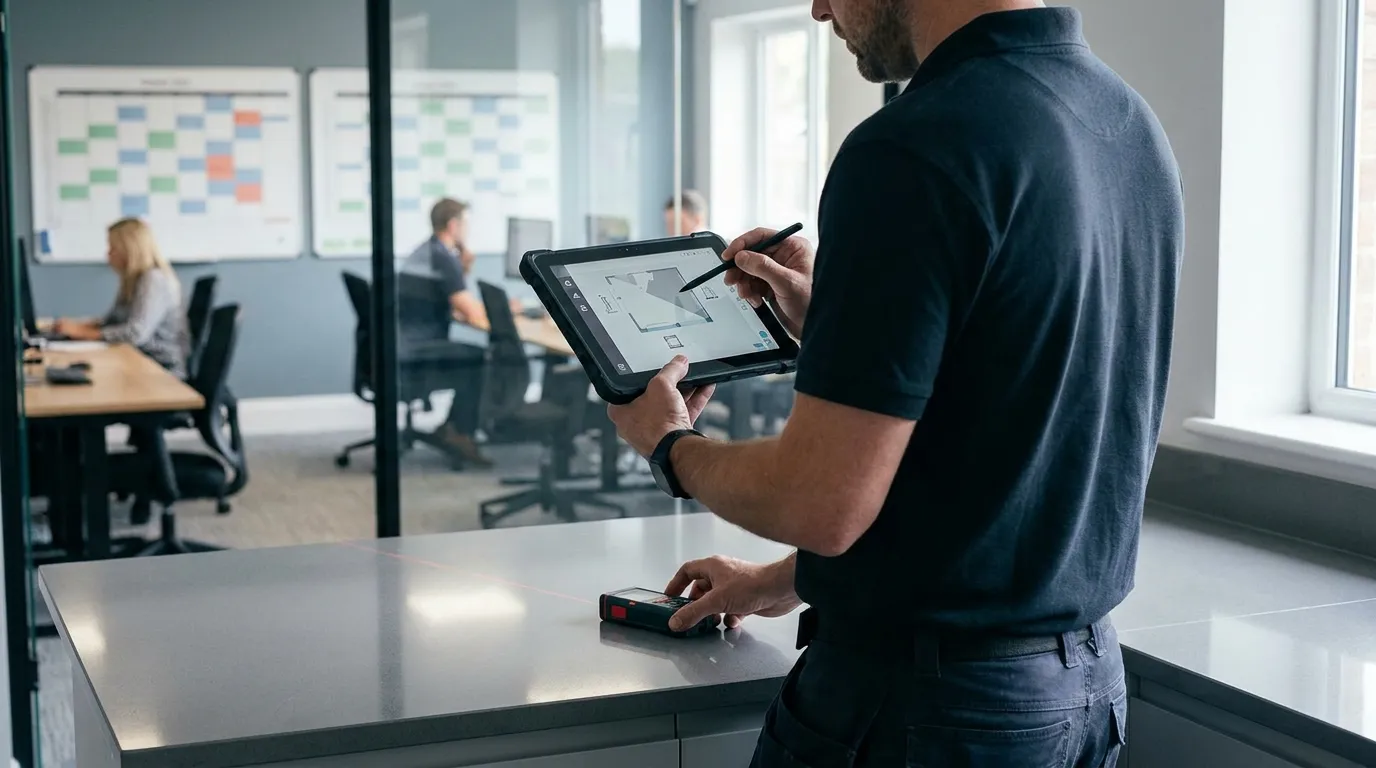
This matters for businesses with office staff, subcontract fitters and mobile templaters, especially when people move between the office, the workshop and customer sites during a normal working day. Shared devices matter as well. A secure system should suit real field jobs and daily routines without leaving job data exposed if a tablet or phone ends up in the wrong hands.

The smart way to choose a safer stone fabrication software security system
When you compare software in 2026, treat security as part of daily operations, not as a separate technical subject. Good stone fabrication software security helps protect your jobs, cash flow, team and reputation. It also supports better data hosting decisions and stronger software compliance, without making things harder for the people using the system each day.
Start with a simple shortlist of questions. Ask where data is hosted, how MFA works, whether roles can be controlled properly, how backups are tested, what compliance documents are available and how integrations are managed. Then ask for clear answers. No waffle. If a supplier avoids detail or hides behind jargon, keep looking for one that explains things clearly and actually makes sense.
For many UK worktop businesses, the best option is software that fits real fabrication workflows and explains its security clearly in plain language. Owners get more confidence, office teams deal with fewer headaches and site teams get safer access to the information they need when jobs are moving fast and no one has time to chase missing details.
Choose a system that helps the business run smoothly and keeps customer and job data protected. Make security part of the buying process now. Do it early. That choice is less likely to create problems later.