

Future-Proofing Your Stone Fabrication Business with Software
Fabrication ERP and stone software help stone workshops cut delays, protect margin and stay in control as demand grows. See how connected workflows link templating, stock, fabrication and installs, and why specialist systems outperform generic tools.
If you run a stone workshop, future-proofing can sound like a big, vague idea. In day-to-day work, fabrication ERP is often part of a much simpler goal. Your business has to keep up when job volume rises, margins get tighter, customers want faster updates, and key staff are off sick or leave. For many granite, quartz, marble and worktop firms, the weak spot isn’t the skill on the shop floor. It’s the flow of information, and that’s where the real trouble starts.
A lot of businesses still rely on spreadsheets, paper packs, wall planners, inboxes, phone calls and WhatsApp. For a while, that works. Then a date shifts, a slab gets promised twice, a cutout note gets missed, or an installer turns up with old details. That’s when the cracks start to show. Small communication gaps turn into delays, mix-ups and wasted time, little by little.
Fabrication ERP and stone software start to matter when pressure builds. They’re not some trendy extra. They give the business a practical way to protect itself as daily work gets harder to handle across teams. The right system helps office teams, templaters, fabricators, fitters and sales staff work from one live source of truth. This guide looks at what future-proofing really means for stone firms, why specialist software matters more than generic tools, where connected workflows save money, and how to choose a setup that supports the next stage of growth.
Why fabrication ERP is really about control
Future-proofing is about keeping day-to-day work steady, not only getting ready for some distant change. In a stone business, small handoff problems can get expensive fast, whether that means a missed revision leading to the wrong edge detail, an old install note wasting a site visit, or a slab that nobody clearly reserved setting off a difficult customer call and lost time in the yard.
The wider market is already heading this way. In a 2024 manufacturing survey, 51% of SMEs said they plan to increase spending on enterprise software such as ERP and CRM. That marks a real shift. The same survey found that 56% of cloud ERP adopters saw lower overall costs. 46% reported improved IT security. Another 46% saw better agility and resilience.
| Metric | Value | Year |
|---|---|---|
| SMEs planning to increase enterprise software spend | 51% | 2024 |
| Cloud ERP adopters reporting reduced overall costs | 56% | 2024 |
| Cloud ERP adopters reporting improved IT security | 46% | 2024 |
| Cloud ERP adopters reporting better agility and resiliency | 46% | 2024 |
For stone fabricators, that matters because the business sits between manufacturing and site delivery. Teams quote custom work, manage materials, coordinate workshop output, and handle on-site installation. When the process depends too much on memory and manual chasing, growing the business starts to feel stressful very quickly.
It’s great to see a slight improvement recorded this year, with 18% of UK respondents sharing data and information through digital tools about life cycle emissions, a two percent increase from 2021.
The quote is about construction data sharing, but the point goes further. Across the UK, digital information still does not move smoothly. Firms that improve that flow early can build an advantage, especially while competitors still work from scattered notes, loose updates, and half-connected systems.
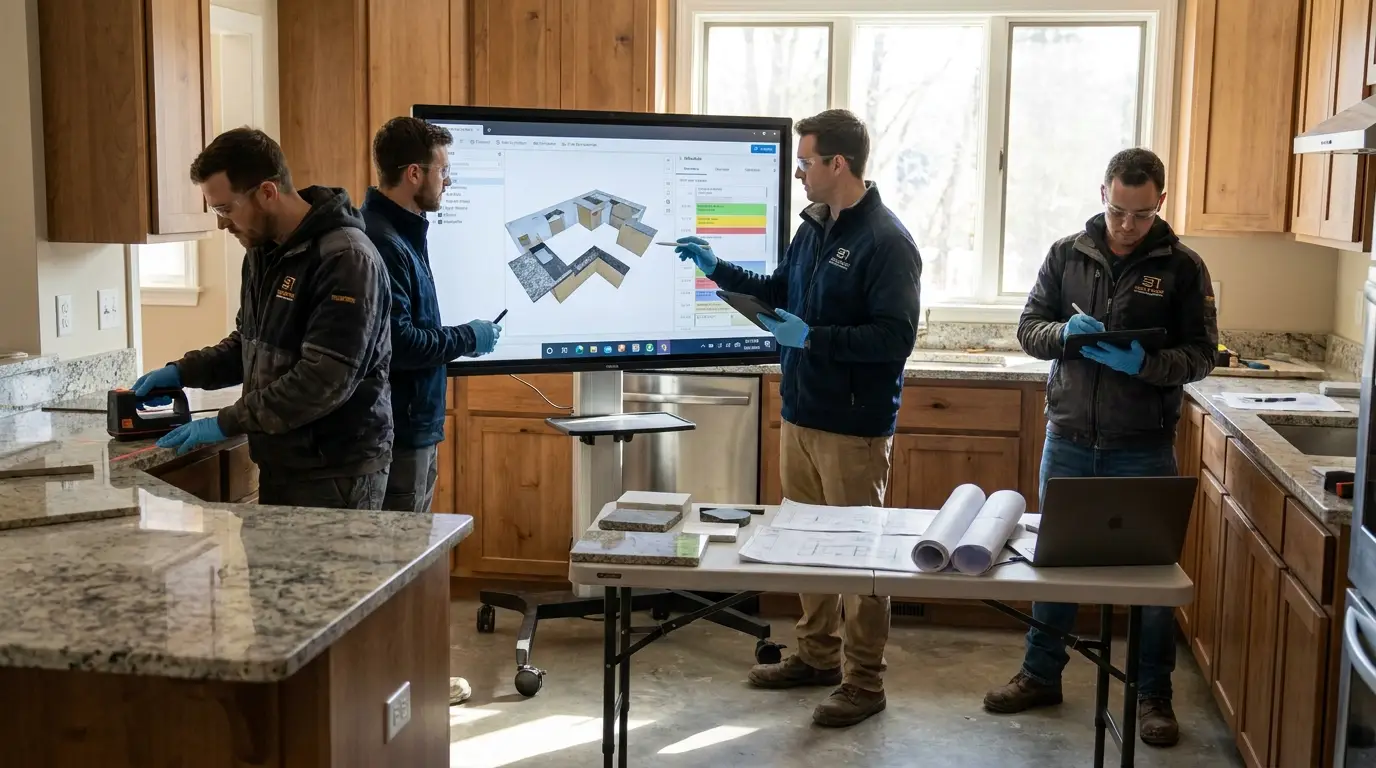
Why generic software often stops short for stone shops
A general job management tool may handle appointments, tasks and customer records well enough. But stone fabrication includes awkward details that generic systems can miss. Stock is not just a simple list of items. It includes slabs, remnants, finishes, thicknesses, colours, layouts and pieces tied to real jobs. The workflow also goes well beyond sales and invoicing. Teams deal with templating, approvals, cutouts, production readiness, install sequencing and CNC handoff too.
Specialist stone software usually works better over time than broad contractor tools because it matches the real work more closely. A solid fabrication ERP setup should support slab reservation, remnant visibility, piece tracking, revision control, purchase orders, workshop status, field updates and invoicing in one connected flow.
Plenty of firms get stuck with software that looked fine in a demo. On paper, the system can log jobs, but it cannot handle the messy middle between survey and install. Staff drift back to side spreadsheets and paper notes. Then the cracks show. Once people start working outside the system, the business loses a reliable source of truth. That gap leads to delays, missed updates and confusion across the team.
For a small to mid-sized worktop business, future-proofing means closing that gap. The office needs to see progress. Templaters need to upload site details. The workshop needs current information. Fitters need to confirm completion without long call chains. Platforms like CutBench are built around that stone-specific workflow instead of forcing fabricators into a generic model.
The workflow links that protect profit over time
The businesses that stay strong over time aren’t always the biggest. They’re the ones with fewer broken handoffs. When each stage connects properly, the business is easier to run, easier to track and much easier to grow over time.
Digital templating makes this easy to see. Recent industry direction suggests it’s becoming more central because it improves measurement accuracy, speeds up approvals, supports quick edits and cuts down on retyping later in the process. For quartz and granite worktops, sink cutouts, hobs, seams, splashbacks and tight tolerances all matter. A lot.
The difference is easy to spot. In a disconnected process, a templater records details on paper or on a device, then someone else enters them again, another person checks the drawings and the workshop ends up working from a printed pack. Every handoff adds risk. In a connected process, template details move straight into drawing approval, fabrication planning and installation notes from the same job record.
The same logic applies to stock and scheduling. Sales teams need a clear view of slab availability, or they can promise the wrong material without noticing. Meanwhile, fabrication dates and install dates need to sit together, or the office ends up spending the day chasing updates. Fitters need the latest notes on site. Otherwise they have to call back for clarification instead of getting on with the job.
A future-proof stone software setup reduces those choke points. It helps the team answer important questions quickly: What is approved? What is booked? What is in fabrication? What is ready to install? What is invoiced? That visibility protects margin because it cuts remakes, delays, wasted trips and the hidden admin time that slowly eats into profit.
Signs your current system will struggle as you grow
Some businesses only start looking for fabrication ERP when things already feel chaotic. It’s better to spot the warning signs early, before the pressure builds and small issues become much harder to manage.
One clear sign is when key staff keep too much of the process in their heads. If one scheduler, estimator or workshop lead is the only person who really knows where jobs stand, the business is exposed. That’s a risk. Duplicate entry is another obvious clue. When staff type the same customer details, dimensions or dates into more than one system, mistakes keep slipping through.
It’s also a warning when software adoption stays limited across the business. Across UK construction, 83% of companies said digital transformation is a priority, and 81% said they were already engaged in it. Still, 73% were using digital construction solutions in no more than 30% of projects. Plenty of firms talk about digital change. Fewer make it part of daily work.
For stone companies, partial adoption can create a false sense of progress. A business may have digital quotes but still rely on paper templating. Or use scheduling software but have no stock link. It may have finance software too while still lacking a simple path from completed install to invoice. Problems can grow in those gaps.
Poor information exchange is another warning sign. A 2024 RICS report found only 20% of UK construction respondents used digital tools on most of their projects, up from 18% before, and the average use across six functions was 12%. If the business still relies on too much chasing, it isn’t alone. Even so, there’s room to improve faster than competitors who move more slowly.
What to look for in a future-proof fabrication ERP setup
A future-proof system needs to do more than look modern. It should help the whole business run with less friction. Start with workflow fit. The software should support a job from enquiry to quote, template, approval, fabrication, installation and invoice, while making sure each role sees the right information without a messy screen.
Then look at stone-specific depth. Good stone software should handle slab-level stock, remnants, cutouts, edge details, revisions and job-based costing. If a business uses digital templating or CNC workflows, ask how data moves from site measure to approval, then into production. Not every feature is needed on day one. What matters is having a system that will not hold the team back later, especially as jobs, staff or production demands increase.
Field use matters too. Templaters and fitters should be able to check details without calling the office for every update. Office teams need to see what changed without digging through messages. Owners and operations managers should be able to spot bottlenecks early, before they become excuses, delays or missed handovers between departments. Small issues can have a big effect.
According to researchers Mahmood, Asghar and Kousha, ERP use among SMEs is rising, and manufacturing leads other sectors in adoption. Their findings showed that manufacturing had the highest ERP adoption rate at 24%, while overall ERP usage grew from 6.7% to 10.9% over the study period. Those numbers support a simple point. Connected software is becoming normal business infrastructure, not just an optional extra.
How to move forward without making it a painful project
Future-proofing does not mean changing everything in one dramatic week. The better option is often simpler. Start by mapping where the business loses time right now, not in theory, in the day-to-day work. Where do details get entered again, where do install changes get missed, and where does stock visibility start to break down? Which tasks still rely on one person remembering to chase somebody else?
Then build a shortlist around the real workflow. For many firms, the right move is specialist stone fabrication workflow software that supports office and field teams together. Keep the buying process practical. Ask the supplier to show your own job types in the demo, not just a polished version that skips the awkward bits. Use real examples like island tops, sink cutouts, re-templated jobs, split installs, and supplier purchases.
A good rollout should fit each role. Sales teams need a clean quote flow. Office teams need visibility and less chasing. Templaters need easy capture and handoff. Fitters need current site info. Owners need reporting that shows what is happening without asking five people. That can make day-to-day work easier for everyone involved.
The aim is a business that can handle more jobs, more staff, and more change without becoming harder to run. Fabrication ERP software should support that, not turn into a project in its own right.
The businesses that adapt best will be the ones that connect the dots
The stone trade isn’t standing still. Customer expectations keep rising, while material and labour costs stay under pressure, and teams need answers faster than before. Businesses still relying on paper, extra spreadsheets and disconnected apps tend to feel that squeeze first.
Fabrication ERP and stone software can make the operation stronger, clearer and less reliant on manual workarounds. The biggest gains can show up in better handoffs, live visibility, cleaner stock control, a faster template-to-fabrication flow and easier install coordination. That’s where it matters.
If you’re deciding what to improve next, skip the flashiest feature. Start with the places where jobs get stuck, details go missing or people lose time chasing each other for updates. Fix those issues first. Then choose software that fits how a real stone workshop runs.
When a business handles that shift well, the team works with more confidence, customers get a smoother experience and the business gets a better foundation for the years ahead. More control. Less complexity. That gives the whole operation more space to keep moving.